

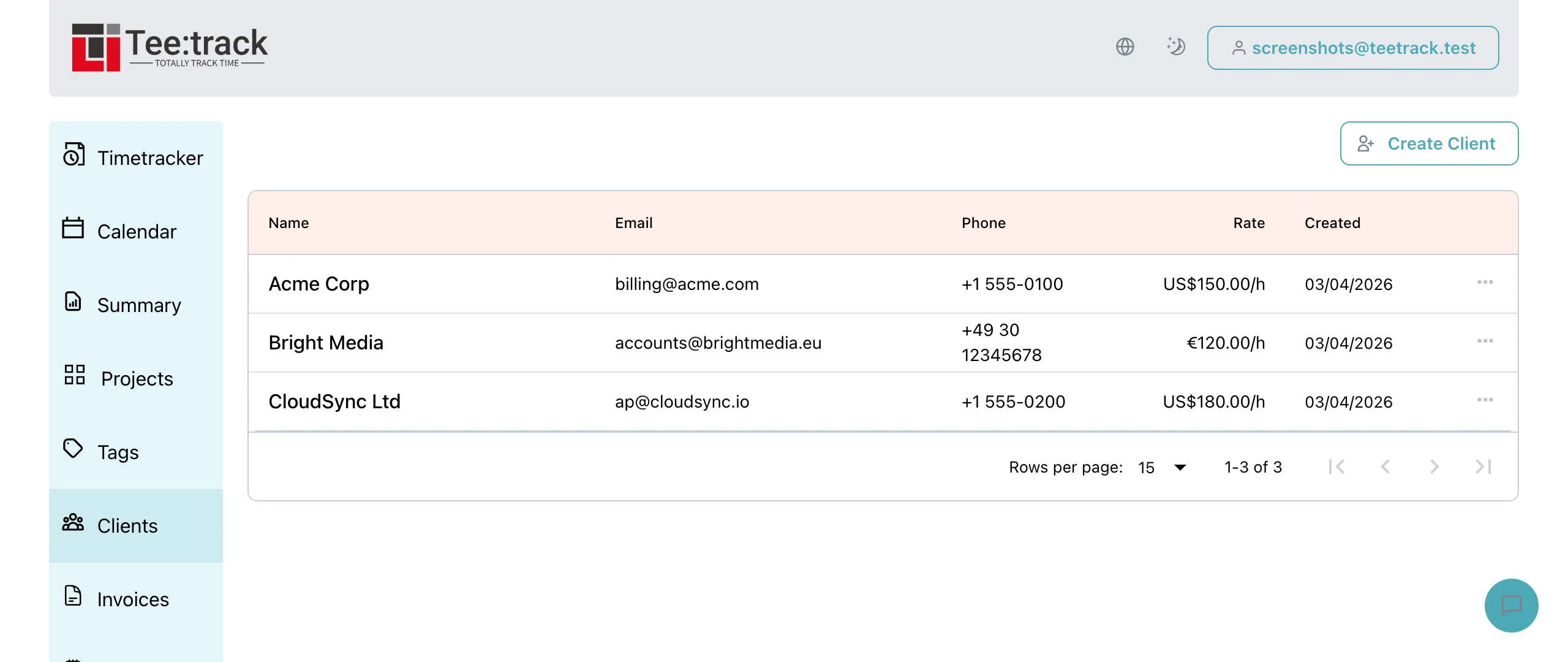
Manage client details and billing defaults
By Tristan Doehl · · Updated
When a client has several projects, repeating their contact details and billing defaults creates extra opportunities for inconsistency. A Teetrack client record gives those projects a shared reference while allowing each engagement to keep its own rate.
Create the client record before its projects
On the Clients page, create a record with the client’s name. Add contact details, address, tax identifier, notes, and a default rate and currency when they are useful to your work. Keeping these details together makes them easier to find when preparing a report or following up on a billing question.
Use notes for information such as a purchase-order reference or the correct finance contact. A stored note is a reference for your process; it does not automatically enforce payment terms or turn a time record into a tax invoice.
Use defaults without losing project-specific agreements
When creating a project, selecting a client can pre-fill its hourly rate and currency. Saving project billing settings requires Business or higher. This pre-fill only happens in the create form; selecting a different client while editing a project does not copy new billing defaults. Review the values before saving each new engagement.
Suppose a client normally pays €100 per hour but agrees to €120 for a specialist project. Keep the client default if it remains useful for other work, and set the project to €120. The project’s saved billing settings are independent, so changing a client record is not a way to rewrite every existing agreement.
Follow the client relationship through reporting
Time entries belong to projects, which link them to the client. In Summary, choose the period and filter to one of that client’s projects. Repeat for each project, or use a shared client tag after checking that it includes exactly the intended entries. There is no separate client filter.
For clients with several projects, check whether the report should combine them or separate distinct engagements. Consistent project names help the recipient relate the entries to their own budget or purchase order.
Keep currencies separate when checking totals
A currency labels the amount attached to a rate. It does not convert one currency into another. If you work with clients in EUR and USD, review their monetary totals separately and use your accounting process for any conversion needed in financial reporting.
Review client records when an agreement or contact changes, then check the settings on the affected projects. That keeps the shared reference useful while preserving the details of each engagement. The client feature overview describes where those records fit into Teetrack.