

Connect agency time, costs, and capacity
By Tristan Doehl · · Updated
An agency needs to know how recorded work relates to the people available, the amount invoiced, and the commitments made to clients. Time tracking supplies part of that picture. It becomes useful for management when it is connected to staffing, accounting, and project records from the same period.
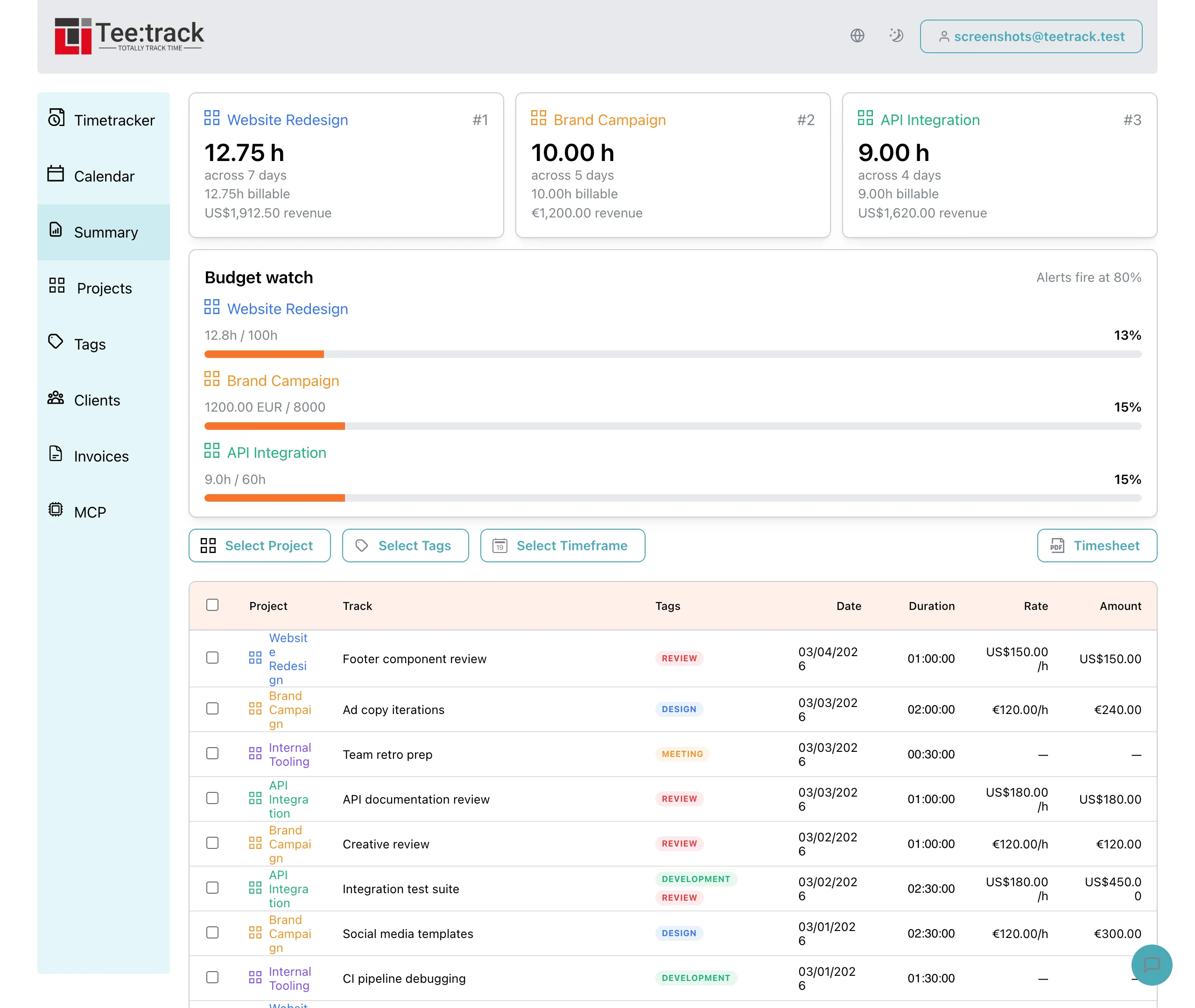
Agree what the team will record
Use consistent client and project names, and define how to describe activities. Decide how billable delivery, internal work, and revisions are classified. A shared definition matters because two people can record the same activity differently while each believes their entry is accurate.
For example, an internal review may be included in a fixed project fee even though it does not create a separate invoice line. Keep its delivery time visible. Omitting that effort makes the project appear cheaper to deliver and can cause the next estimate to be too low.
Each Teetrack account belongs to one person. Teetrack has no team workspace, shared staffing view, or payroll system. An agency combining individual records needs a separate authorised process for collecting them and managing access.
Compare delivery hours with available time
Utilization measures billable delivery hours as a share of available working hours under a stated definition. Choose how leave and public holidays affect the denominator, then use the same convention when comparing periods. Internal administration should remain visible rather than being removed solely to improve the percentage.
Compare the split of work by role as well as across the agency. A project lead may spend time coordinating work that a delivery specialist can bill directly. Check responsibilities and missing entries before treating a lower utilization figure as unused capacity.
The profitability guide explains how utilization connects to invoicing and costs. The utilization calculator can help explore the arithmetic once the inputs are defined.
Compare delivered value with invoices and costs
Work recorded as billable is not necessarily invoiced at its standard value. Fixed fees, discounts, or agreed write-offs can create a difference. A realization calculation compares the amount invoiced for that work with its potential billable amount using consistent rates and scope.
Profitability needs another set of inputs: the costs of delivering the work and running the business. Time entries alone cannot supply salaries, supplier bills, all overhead, or invoice payment status. Reconcile the relevant records before describing a margin as the result for a project or period.
Use the records to plan upcoming capacity
Past entries help estimate the time required for familiar work, but a forecast also needs planned leave, the skills required, and confirmed future commitments. Build the next few weeks from those inputs, then compare remaining capacity with the pipeline.
A team can have spare hours overall and still lack the specialist needed for a particular delivery date. Review capacity by person or skill as well as in aggregate. The capacity-planning guide develops a worked example and explains how to avoid subtracting overhead twice.
Report the decisions that follow
A client report should connect the work to the agreed deliverables and identify what happens next. Show enough hours and budget information to explain a variance, then state any decision required from the client. Keep the detailed timesheet available as supporting evidence.
For example, additional revision time matters because it may change the remaining scope or date. Reporting that relationship is more useful than presenting a longer list of tasks. The client-reporting guide shows a compact example with a clear approval request.
Establish one consistent review period
Begin with a period for which the time, staffing, and accounting records can be reconciled. Record the assumptions behind each measure so the next comparison uses the same basis. The freelance billing guide covers the simpler individual workflow; agency review adds the responsibility of making those definitions consistent across people and projects.
Frequently asked questions
What does utilization measure?
It measures billable delivery hours divided by available working hours under a defined convention. State how leave and holidays affect availability and use the same definition across periods.
Can time records alone establish agency profit?
No. Profitability also needs revenue and cost records, including delivery costs and overhead. Payment status belongs in the accounting process rather than being inferred from billable time.
What should a client report explain?
Connect agreed deliverables, completed work, hours or budget used, and the next required decision. Provide the detailed timesheet separately when the client needs it.
How far ahead should capacity planning look?
Choose a horizon long enough for your staffing and client commitments. A six-week view is a workable example, but it should reflect the lead times and uncertainty in your own pipeline.
Does a high utilization percentage prove good performance?
No. Check role, work quality, recording completeness, scope, and realization. A percentage describes a split of time and needs context before it supports a management decision.